

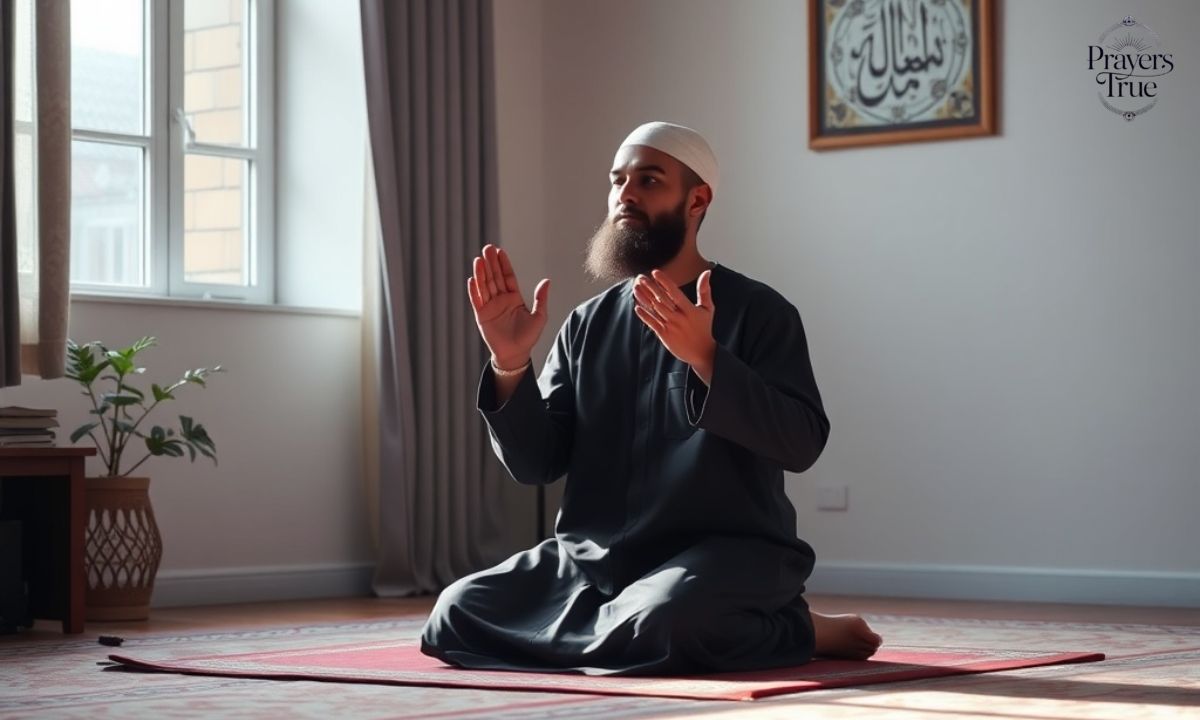
Salat al-Istikhara is a special prayer Muslims perform when they need guidance in making an important decision. It was taught by the Prophet Muhammad as a way to seek help from Allah when someone feels unsure about a matter such as marriage, work, travel, or other life choices. The purpose of Istikhara is to ask Allah to guide you toward what is best and keep you away from what may bring harm or difficulty.
To perform Istikhara, first make the intention and pray two rakats of voluntary (nafl) prayer. After completing the prayer, recite the Dua of Istikhara, asking Allah for guidance and placing your trust in His wisdom. After making this supplication sincerely, continue with your decision while trusting that Allah will guide your heart and arrange circumstances in the best way for you.
Istikhara Prayers 🤲

The Classic Istikhara Du’a (From Sahih al-Bukhari)
“Allahumma inni astakhiruka bi’ilmika, wa astaqdiruka bi-qudratika, wa as’aluka min fadlika al-‘azim. Pu-innaka taqdiru wa la aqdiru, wa ta’lamu wa la a’lamu, wa anta ‘allamu al-ghuyub.”
O Lord, with Your knowledge I seek guidance, with Your power I seek strength, and with Your mercy I seek forgiveness. You are capable and I am powerless, You know and I do not, and You are the Knower of the unseen.
Short Personal Supplication
O Allah, if this matter is beneficial for my religion, world and Hereafter then make it easy for me and bless me in it. If it is harmful — turn it away from me and turn me away from it, and decree for me what is good wherever it may be.”
Brief Heart Prayer
“Ya Allah, You know what I do not know. Guide my heart to what is best, and make me content with Your decree.”
Simple Morning Istikhara
“O Allah, I place this matter in Your hands. Grant me clarity, ease my heart, and guide my steps toward what pleases You.”
Trust After Istikhara
— Spoken as they sing the following prayer: “Oh Allah, I commit this matter to Thee.,” where this is a verbalized song of prayer. Now I trust You completely. Whatever You choose for me is better than what I could choose for myself.”
What is istikhara?
Salat-al-Istikhara: This is actually the Prayer of seeking plans which Prophet Muhammad (peace be upon him) constantly taught that it is an integral section of asking Allah’s influence while decision making from impossible to possible.
The process is as follows by praying two voluntary rakahs (parts of the prayer) and then making a dua to Allah.The word Istikhara comes from the Arabic root meaning “to seek goodness,” reflecting the believer’s trust that Allah alone knows what is truly best for them.
It is performed when a Muslim stands at a crossroads — whether in matters of marriage, career, travel, or any significant life choice — and feels uncertain about which path to take. Rather than relying solely on their own judgment, they turn to Allah with humility and sincerity.
The answer to Istikhara does not always come as a dream, as many believe. More often, it arrives through a feeling of ease or unease in the heart, through doors opening or closing, or through a quiet sense of peace that settles after sincere supplication.
What makes Istikhara beautiful is its core message — that a believer never has to face life’s decisions alone. By performing it, one acknowledges that Allah’s knowledge is infinite, His wisdom is perfect, and His plan is always better than anything we could choose for ourselves.
When to Pray Istikhara
Istikhara is prayed whenever a Muslim faces a decision that is permissible in Islam but uncertain in outcome — a moment where the heart hesitates and the mind cannot settle on a clear answer alone.
It is most commonly sought in life’s major crossroads, such as deciding on a marriage proposal, accepting a new job, starting a business, choosing a place to live, or embarking on an important journey. These are the moments when the weight of a choice feels too significant to carry without divine guidance.
However, Istikhara is not reserved only for grand decisions. Scholars have noted that it can be performed for any matter, big or small, as long as it is something lawful and the person genuinely feels uncertain. If the heart is unsettled and the way forward is unclear, that is a sign that Istikhara is needed.
There are times, though, when Istikhara is not necessary. It should not be performed for acts that are already obligatory, such as praying or fasting, nor for anything that is clearly forbidden in Islam. There is no need to seek guidance on what Allah has already made clear.
The best time to pray Istikhara is when the decision is before you and you have not yet made up your mind. It is a prayer of openness — one that says to Allah, “I do not know, but You do.” It should be prayed with a heart free of attachment to a specific outcome, fully surrendered to whatever Allah chooses.
Ultimately, Istikhara can be repeated more than once if clarity does not come immediately. It is not a single moment but a continuous act of turning to Allah for as long as the matter remains unresolved.
How to Pray Istikhara
Istikhara is a simple yet deeply meaningful act of worship that any Muslim can perform. It requires no special setting or elaborate preparation — only sincerity, purification, and a heart that is truly ready to accept whatever Allah decrees.
The first step is to make wudu, the ritual purification that prepares the body and soul for standing before Allah. Just as with any prayer, cleanliness of the body reflects the intention of the heart.
Once purified, pray two voluntary rakahs — not the obligatory daily prayers, but two units offered specifically for the purpose of seeking guidance. In the first rakah, it is recommended to recite Surah Al-Kafirun after Surah Al-Fatiha, and in the second rakah, Surah Al-Ikhlas. These are not strict conditions, but they are a beautiful and meaningful tradition.
After completing the two rakahs and offering the final salaam, turn your heart fully to Allah and recite the Istikhara dua as taught by the Prophet Muhammad (peace be upon him). When you reach the part of the dua that mentions “this matter,” bring your specific need or decision to mind with full presence and sincerity.
The dua itself is a profound declaration of trust. It acknowledges that Allah knows what you do not, that He has power where you have none, and that whatever He chooses for you is better than anything you could choose for yourself.
After making the dua, do not wait passively for a dream or a sign. Instead, move forward with your affairs while keeping your heart open. If the matter is good for you, Allah will make it easy and place peace in your heart toward it. If it is not, He will create distance between you and it, even if you cannot immediately understand why.
There is no fixed time of day for Istikhara, though many scholars recommend praying it at night before sleeping, as the heart is quieter and more receptive. It can also be repeated on multiple days if clarity has not yet come, as there is no limit to how many times one may seek Allah’s guidance on the same matter.
Istikhara Dua in Arabic
The Istikhara dua was taught by the Prophet Muhammad (peace be upon him) and recorded in Sahih al-Bukhari. It is recited after the two voluntary rakahs, with full presence of heart and sincere intention toward the matter at hand.
اللَّهُمَّ إِنِّي أَسْتَخِيرُكَ بِعِلْمِكَ، وَأَسْتَقْدِرُكَ بِقُدْرَتِكَ، وَأَسْأَلُكَ مِنْ فَضْلِكَ الْعَظِيمِ
فَإِنَّكَ تَقْدِرُ وَلَا أَقْدِرُ، وَتَعْلَمُ وَلَا أَعْلَمُ، وَأَنْتَ عَلَّامُ الْغُيُوبِ
اللَّهُمَّ إِنْ كُنْتَ تَعْلَمُ أَنَّ هَذَا الْأَمْرَ خَيْرٌ لِي فِي دِينِي وَمَعَاشِي وَعَاقِبَةِ أَمْرِي فَاقْدُرْهُ لِي وَيَسِّرْهُ لِي ثُمَّ بَارِكْ لِي فِيهِ
وَإِنْ كُنْتَ تَعْلَمُ أَنَّ هَذَا الْأَمْرَ شَرٌّ لِي فِي دِينِي وَمَعَاشِي وَعَاقِبَةِ أَمْرِي فَاصْرِفْهُ عَنِّي وَاصْرِفْنِي عَنْهُ
وَاقْدُرْ لِي الْخَيْرَ حَيْثُ كَانَ ثُمَّ أَرْضِنِي بِهِ
“O Allah, I seek Your guidance through Your knowledge, I seek ability through Your power, and I ask You from Your great bounty,” is how it translates in English.. For You are able and I am not, You know and I do not, and You are the Knower of all unseen things. O Allah, if You know that this matter is good for me in my religion, my livelihood, and the outcome of my affairs, then decree it for me, make it easy for me, and bless me in it. And if You know that this matter is bad for me in my religion, my livelihood, and the outcome of my affairs, then turn me away from it, determine what is right wherever it may be, and then make me happy with it.”
When reciting the dua, the words “this matter” are the moment where you silently or verbally bring your specific situation to mind. You do not need to say it aloud — Allah already knows what is in your heart. What matters most is that you arrive at this dua with complete surrender, genuine uncertainty, and unwavering trust that Allah’s answer, whatever it may be, is the greatest gift you could receive.
Istikhara Dua in English
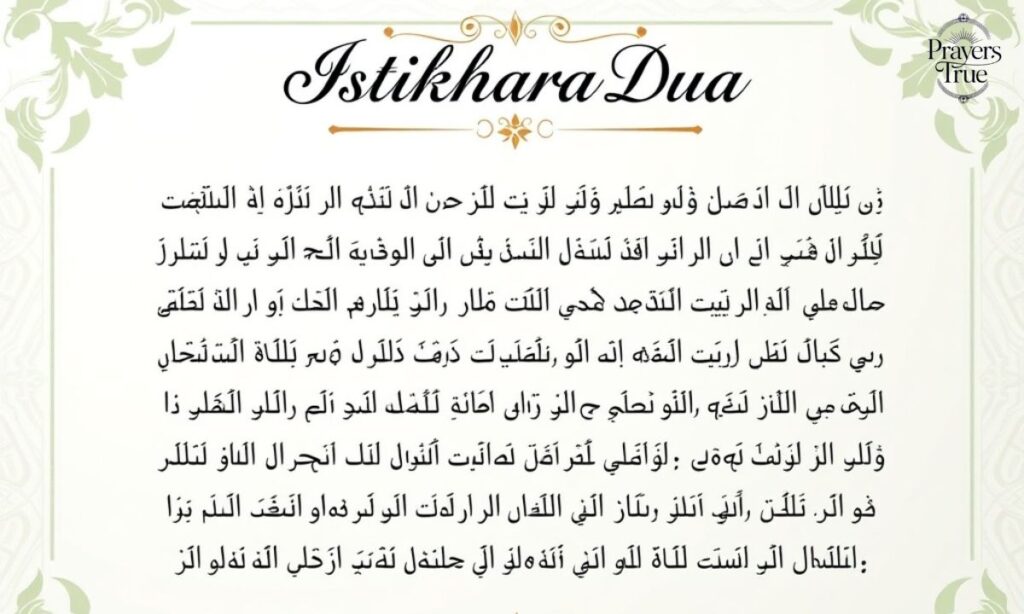
The Istikhara dua is one of the most beautiful supplications in Islam. Every word carries profound meaning, reflecting a believer’s complete trust in Allah’s knowledge, power, and infinite wisdom. Below is the full dua in English, so that its meaning may settle deeply in the heart of every person who recites it.
“O Allah, I ask You from Your great bounty, and I seek Your guidance through Your knowledge, and I seek ability through Your power.”
“You know and I do not, You are the Knower of all unseen things, and You are able and I am not.”
“O Allah, if You know that this matter is good for me in my religion, my livelihood, and the outcome of my affairs — then decree it for me, make it easy for me, and bless me in it.”
“And if you are aware that this issue is detrimental to my religion, my means of subsistence, and the results of my affairs, then turn it away from me and turn me away from it.”
“And decree for me what is good wherever it may be, then make me pleased with it.”
What makes this dua so powerful is not just its words, but the profound admission it contains. The believer stands before Allah acknowledging three fundamental truths — that Allah knows what they do not know, that Allah has power where they have none, and that Allah’s choice will always be better than their own.
The phrase “this matter” in the middle of the dua is a deeply personal moment. It is where you bring your specific situation before Allah — your decision, your uncertainty, your hope. You do not need to speak it aloud, for Allah already knows what weighs on your heart.
Recite this dua slowly, with full awareness of its meaning, and allow each word to be a genuine expression of surrender. That sincerity is what transforms it from mere words into a true conversation with Allah.
Frequently Asked Questions
What is an Istikhara prayer?
Istikhara is a special prayer performed by Muslims when they seek guidance from Allah about an important decision. It helps a person ask Allah to guide them toward what is best and keep them away from what may be harmful.
When should you pray Istikhara?
Istikhara can be prayed when you are unsure about a halal decision, such as marriage, work opportunities, travel, or other life matters where guidance is needed.
How many rakats are in Istikhara prayer?
Istikhara consists of two voluntary (nafl) rakats of prayer, followed by the special dua asking Allah for guidance.
Do you have to see a dream after Istikhara?
No, seeing a dream is not necessary. Guidance may come through peace in the heart, clarity about the decision, or circumstances that make the path easier or more difficult.
Can Istikhara be prayed more than once?
Yes, if you still feel unsure, you can perform Istikhara multiple times until you feel more confident about the decision.
Can someone else pray Istikhara for you?
It is best for the person making the decision to pray Istikhara themselves, but others can also make dua asking Allah to guide you.
When is the best time to pray Istikhara?
Istikhara can be prayed at any time except during the prohibited prayer times. Many people prefer praying it after the Isha prayer or before going to sleep.
Is Istikhara only for big decisions?
While it is commonly used for major life choices, you can pray to Istikhara for any decision where you want Allah’s guidance.
What should you do after praying Istikhara?
After performing Istikhara, trust Allah and proceed with the option that feels right while observing how circumstances unfold.
Can Istikhara change your destiny?
Istikhara is a way to seek Allah’s guidance and blessings in your decision. It helps a believer rely on Allah and choose the path that brings goodness in this life and the next.
Conclusion
Istikhara is a beautiful and powerful way for Muslims to seek guidance from Allah when facing important decisions. By praying two rakats and sincerely making the Istikhara dua, a person places their trust in Allah’s wisdom and asks for help in choosing what is best. This prayer reminds believers that Allah knows what is beneficial for them, even when they may feel uncertain or confused.
After performing Istikhara, it is important to move forward with faith and patience, trusting that Allah will guide your heart and circumstances in the right direction. Whether the path becomes easier or a different opportunity appears, believers can feel peace knowing they sought guidance from Allah before making their decision.

Riya is a passionate writer with 4 years of experience creating inspiring prayer blogs. She currently works at PrayersTrue.com, sharing heartfelt words that bring peace, hope, and spiritual strength to readers worldwide.