

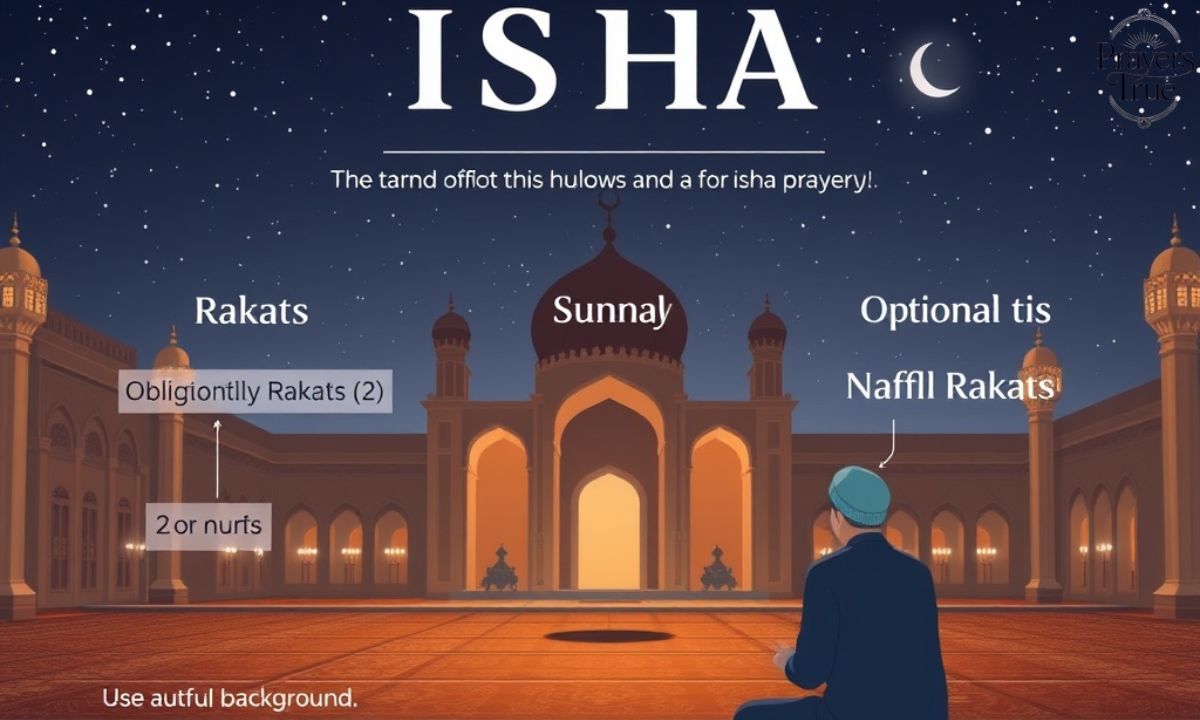
The Isha prayer is the fifth and final obligatory prayer in Islam, performed at night after the twilight has disappeared. Muslims around the world offer this prayer to end their day with remembrance of Allah, seeking forgiveness, peace, and spiritual connection. Like the other daily prayers, Isha includes a combination of obligatory (Fard), Sunnah, and optional (Nafl) rakats, each carrying its own importance and reward.
Understanding how many rakats are in Isha prayer helps Muslims perform their worship correctly and follow the practice of Prophet Muhammad (peace be upon him). The Isha prayer typically consists of 4 Fard rakats, along with Sunnah and Nafl prayers, and it is often followed by the Witr prayer, which holds special significance. Knowing this structure allows believers to complete their nightly prayer with devotion and clarity.
Getting Started With The Name Of Almighty Allah

Bismillah: The Sacred BeginningIn Islamic tradition, beginning any meaningful action with the name of Almighty Allah — Bismillah ir-Rahman ir-Raheem (In the name of Allah, the Most Gracious, the Most Merciful) — is one of the most profound and cherished practices. This sacred invocation serves as a reminder that everything we do, no matter how small or grand, is ultimately connected to the divine. By starting with His name, a believer acknowledges that all ability, strength, and blessing flow from Allah alone, grounding every effort in humility and gratitude.
A Timeless Practice Rooted in PurposeThe practice of beginning with Allah’s name is not merely a ritual — it is a spiritual orientation that transforms ordinary actions into acts of worship. Whether one is starting a meal, beginning a journey, opening a book, or embarking on a new chapter of life, invoking Allah’s name fills that moment with intention and divine blessing (barakah). The Prophet Muhammad (peace be upon him) emphasized that any significant matter not begun with the remembrance of Allah is left incomplete. In this way, Bismillah becomes the believer’s anchor — a daily, living connection between the human soul and its Creator.
Understanding the 9-Rakat Isha Prayer
The Structure of the Isha PrayerThe Isha prayer, performed after nightfall, carries a beautiful depth in its structure. While the full Isha prayer can include up to 17 rakats in total, the essential 9-rakat framework consists of the core components a Muslim is most strongly encouraged to observe: 4 rakats of Fard (obligatory prayer), 2 rakats of Sunnah Mu’akkadah (emphasized sunnah), and 3 rakats of Witr (the closing odd-numbered prayer). Together, these nine rakats form the spiritual backbone of the Isha prayer, combining obligation, prophetic tradition, and a unique final devotion that seals the night with remembrance of Allah.
The Significance of Each ComponentEach portion of the 9-rakat Isha prayer carries its own spiritual weight. The 4 Fard rakats are the non-negotiable duty of every Muslim, representing direct submission to Allah’s command. The 2 Sunnah rakats follow the blessed practice of the Prophet Muhammad (peace be upon him), earning the believer additional reward and closeness to the divine. The 3-rakat Witr prayer, which is prayed last, holds a special place in Islamic worship — the Prophet (PBUH) said, “Make Witr your last prayer of the night.” It is the believer’s final whisper to Allah before sleep, making the 9-rakat Isha prayer a complete and deeply meaningful close to the day.
How to Perform the 9-Rakat Isha Prayer

Performing the 4 Rakats Fard and 2 Rakats Sunnah
Begin the Isha prayer by making a sincere intention (Niyyah) in your heart to perform the Fard prayer. Stand facing the Qiblah, raise both hands to your earlobes, and say “Allahu Akbar” (the opening Takbeer) to enter the prayer. Recite Surah Al-Fatiha followed by any short Surah in the first two rakats, bowing (Ruku), prostrating (Sujood), and completing all four rakats in the standard manner — sitting for Tashahhud after the second rakat and concluding with Salaam after the fourth. After a short pause, rise again and perform the 2 rakats of Sunnah Mu’akkadah in the same way, reciting Al-Fatiha and a short Surah in both rakats and concluding with Salaam. These six rakats establish your obligatory duty and your connection to the Prophetic practice.
Completing the 3 Rakats Witr
The Witr prayer is the crown of the night and should be performed last. Make your intention for 3 rakats of Witr, then begin with Takbeer. In the first two rakats, follow the standard format — reciting Al-Fatiha and a Surah, performing Ruku and Sujood — and sit for Tashahhud after the second rakat without saying Salaam. Rise for the third rakat, recite Al-Fatiha and a Surah, and before going into Ruku, raise your hands and recite Dua al-Qunoot — a heartfelt supplication asking Allah for guidance, forgiveness, and mercy. Then complete the Ruku and Sujood as normal and conclude with the final Salaam. With this, your 9-rakat Isha prayer is complete — your day has been sealed with devotion, and your night now begins in the peace of Allah’s remembrance.
Are There 17 Rakats in Isha Prayer?

Yes — The Full Isha Prayer Can Consist of 17 Rakats
The Isha prayer, when performed in its most complete and comprehensive form, can indeed total 17 rakats. This full count includes every category of prayer associated with Isha: 4 rakats of Sunnah Ghair Mu’akkadah (non-emphasized sunnah, prayed before the Fard), 4 rakats of Fard (the obligatory prayer), 2 rakats of Sunnah Mu’akkadah (the emphasized sunnah after Fard), 2 rakats of Nafl (optional voluntary prayer), 3 rakats of Witr (the closing prayer), and 2 rakats of Nafl (additional voluntary prayer after Witr). Together, these form the complete spiritual experience of Isha that a deeply devoted Muslim may choose to observe every night.
What Is Obligatory and What Is Optional
It is important to understand that not all 17 rakats carry the same level of obligation. Only the 4 rakats of Fard are absolutely compulsory — leaving them without a valid excuse is a serious sin. The 2 rakats of Sunnah Mu’akkadah and 3 rakats of Witr are very strongly emphasized and should not be neglected without reason, as they were the consistent practice of the Prophet Muhammad (peace be upon him). The remaining rakats — the 4 Sunnah Ghair Mu’akkadah and the Nafl prayers — are voluntary acts of worship that multiply a believer’s reward and deepen their closeness to Allah, but are not sinful to omit. Every extra rakat prayed is a gift a Muslim gives to their own soul.
How Many Rakats Are Compulsory in Isha Prayer?
The Compulsory Rakats of Isha Prayer
In the Isha prayer, only 4 rakats of Fard (obligatory) are truly compulsory. These four rakats are the non-negotiable, divine obligation placed upon every adult Muslim of sound mind. Performing them is a direct command from Allah, and deliberately leaving them without a valid Islamic reason is considered a major sin. These 4 Fard rakats must be prayed with full concentration, proper physical posture, and sincere intention — they are the absolute minimum that fulfills a Muslim’s duty for the Isha prayer. No other category of Isha prayer — whether Sunnah, Witr, or Nafl — carries the same level of strict obligation as these four rakats.
The Near-Compulsory Prayers You Should Never Skip
While only the 4 Fard rakats are strictly compulsory, Islamic scholars strongly emphasize that the 3 rakats of Witr hold a near-obligatory status that every Muslim should take seriously. According to the Hanafi school of thought, Witr is considered Wajib (necessary) — one level below Fard but far above optional. The 2 rakats of Sunnah Mu’akkadah are also heavily emphasized, as the Prophet Muhammad (peace be upon him) performed them consistently and rarely left them. While missing these prayers does not carry the same sin as missing the Fard, neglecting them regularly is strongly discouraged and represents a significant spiritual loss. In short, a Muslim’s minimum duty is 4 rakats, but their complete devotion calls for the full 9 to 17 rakats of Isha.
Is Witr Prayer Part of Isha?
The Relationship Between Witr and Isha Prayer
The Witr prayer is not a standalone prayer independent of Isha — it is deeply and inseparably connected to the Isha prayer in Islamic practice. Scholars across all major schools of thought agree that Witr is prayed after Isha and cannot be performed before it. In this sense, Witr is considered an extension and a concluding component of the Isha prayer experience, even if it is technically classified as its own category of worship. The Prophet Muhammad (peace be upon him) never prayed with Witr before performing Isha, establishing a clear and consistent order that Muslims follow to this day. Whether you pray the minimum 9 rakats or the full 17 rakats of Isha, Witr always comes last — serving as the spiritual seal of the night.
The Status of Witr in Islamic Law
Scholars have differed slightly on the precise classification of Witr, but all agree on its exceptional importance. According to the Hanafi school, Witr is Wajib — meaning it is necessary and obligatory in a practical sense, sitting just below the level of Fard. According to the Shafi’i, Maliki, and Hanbali schools, Witr is a highly emphasized Sunnah (Sunnah Mu’akkadah) that should never be casually abandoned. The Prophet (PBUH) said, “Witr is a duty upon every Muslim” — reflecting its profound weight in daily worship. Regardless of scholarly classification, every Muslim is strongly urged to protect their Witr prayer every single night, as it represents their last conversation with Allah before sleep and a beautiful act of devotion that closes the day in divine remembrance.
Total Rakats in Isha Prayer: A Detailed Breakdown

A Complete Breakdown of All Isha Rakats
The Isha prayer, when performed in its fullest form, is a rich and layered act of worship composed of several distinct categories of prayer. The complete breakdown is as follows: 4 rakats of Sunnah Ghair Mu’akkadah are prayed first as a voluntary opening, though they are non-emphasized and optional. These are followed by the 4 rakats of Fard — the compulsory heart of the Isha prayer that every Muslim must perform. After the Fard, 2 rakats of Sunnah Mu’akkadah are prayed as a strongly emphasized prophetic practice. This is then followed by 2 rakats of Nafl, which are voluntary prayers offering additional spiritual reward. The prayer sequence then moves to the 3 rakats of Witr, which serve as the near-obligatory closing prayer of the night. Finally, 2 more rakats of Nafl may be offered after Witr as an extra act of devotion, bringing the grand total to 17 rakats in the most complete form of Isha.
Understanding the Levels of Importance
Not every rakat in the Isha prayer carries equal weight, and understanding their levels of importance helps every Muslim prioritize correctly. The table below provides a clear and organized breakdown:
| Prayer | Rakats | Category | Status |
| Sunnah Ghair Mu’akkadah | 4 | Before Fard | Optional |
| Fard | 4 | Obligatory | Compulsory |
| Sunnah Mu’akkadah | 2 | After Fard | Strongly Emphasized |
| Nafl | 2 | After Sunnah | Optional |
| Witr | 3 | After Nafl | Wajib / Emphasized Sunnah |
| Nafl | 2 | After Witr | Optional |
| Total | 17 |
Every Muslim should ensure they never miss the 4 Fard rakats, should strongly protect their 3 Witr and 2 Sunnah Mu’akkadah rakats, and should strive — as much as their time and energy allow — to complete the full 17 rakats of Isha for maximum spiritual reward and closeness to Allah.
The Spiritual Significance of Isha Prayer
Isha Prayer: A Sacred Covenant With Allah in the Night
Of all the five daily prayers, the Isha prayer holds a uniquely profound spiritual significance — it is the prayer performed when the world grows quiet, distractions fade, and the soul stands most vulnerably and sincerely before its Creator. Allah specifically mentions the night prayer in the Holy Quran, honoring those who leave their beds and comfortable rest to remember Him in the stillness of darkness. The Isha prayer is not merely a ritual obligation — it is a deeply personal meeting between the believer and Allah, a moment where the noise of the day is silenced and the heart speaks directly to the Most Merciful. By choosing to stand in prayer when others sleep, a Muslim demonstrates that their love and devotion for Allah surpasses the comfort of this worldly life.
The Immense Rewards and Blessings of Isha Prayer
The Prophet Muhammad (peace be upon him) spoke extensively about the extraordinary rewards attached to the Isha prayer, elevating its status among the daily acts of worship. He (PBUH) said that whoever prays Isha in congregation receives the reward as though they had prayed half the night, and whoever prays both Fajr and Isha in congregation receives the reward of praying the entire night in worship. This immense spiritual reward reflects how deeply Allah values the sacrifice of a believer who overcomes fatigue and worldly comfort to fulfill their duty. Beyond reward, the Isha prayer serves as a powerful spiritual shield — it purifies the soul from the sins and mistakes of the day, renews the believer’s connection with Allah, and fills the heart with tranquility and divine light before sleep. Every night a Muslim prays Isha with sincerity and presence of heart, they go to sleep not as someone who merely survived another day, but as someone who ended it in the most honorable and blessed state possible — in the remembrance and pleasure of Almighty Allah.
Common Mistakes in Isha Prayer and How to Avoid Them
Common Mistakes That Weaken the Quality of Isha Prayer
Despite the best intentions, many Muslims unknowingly fall into habits that diminish the quality and validity of their Isha prayer. One of the most widespread mistakes is praying too quickly — rushing through the rakats without allowing proper stillness in Ruku and Sujood. Islamic scholars emphasize that every posture must be held with complete tranquility (Tuma’ninah), and a prayer performed in haste is spiritually and in some opinions legally deficient. Another common error is neglecting the Niyyah (intention) — many Muslims begin prayer without consciously affirming in their heart which prayer they are performing and how many rakats they intend. Additionally, incorrect recitation of Al-Fatiha is alarmingly common, as mispronouncing certain letters can alter the meaning of the words of Allah. Muslims are strongly urged to study proper Tajweed and regularly review their recitation with a qualified teacher to ensure their words reach Allah in the most correct and beautiful form possible.
How to Protect and Perfect Your Isha Prayer
Avoiding mistakes in Isha prayer requires consistent awareness, education, and spiritual mindfulness. First and foremost, every Muslim should pray with full presence of heart (Khushu) — turning off distractions, choosing a clean and quiet space, and reminding themselves before every Takbeer that they are standing before the Creator of the universe. A powerful habit is to pause briefly before beginning prayer and consciously clear the mind of worldly thoughts. Muslims should also ensure they maintain proper alignment of the prayer rows when praying in congregation, as the Prophet (PBUH) strongly emphasized straightening the rows as a sign of unity and discipline. Furthermore, never delaying Isha beyond its recommended time without necessity is essential — praying it too late out of negligence robs the believer of the full barakah and reward attached to its proper time. Finally, making it a regular practice to learn and understand the meaning of the duas and Surahs recited in prayer transforms every rakat from mere physical movement into a deeply conscious and spiritually alive conversation with Almighty Allah.
Benefits of Performing Sunnah and Nafl Rakats
1. A Guaranteed Home in Paradise
One of the greatest benefits of performing Sunnah rakats is the divine promise of a home in Jannah. The Prophet Muhammad (peace be upon him) confirmed in an authentic Hadith that whoever consistently preserves their daily Sunnah prayers, Allah will build for them a house in Paradise. Every Sunnah rakat prayed is an investment no worldly wealth can ever match — a brick laid in an eternal home that lasts forever.
2. Drawing Closer to Allah
Nafl rakats are the most direct path to earning Allah’s special love. In a Hadith Qudsi, Allah declares that His servant draws nearer to Him through voluntary worship until Allah loves him deeply. This divine closeness brings barakah, inner peace, and protection into every area of the believer’s life — making Nafl prayer not just extra worship, but a living connection with the Most Merciful.
Frequently Asked Questions
What are the total rakats in Isha prayer?
Isha prayer usually consists of 17 rakats in total: 4 Sunnah (optional), 4 Fard (obligatory), 2 Sunnah, 2 Nafl, 3 Witr (obligatory according to some schools), and 2 Nafl. However, the most essential part is the 4 Fard rakats.
Which rakats in Isha prayer are obligatory?
The 4 Fard rakats are obligatory for every Muslim. These must be performed and cannot be skipped.
Are Sunnah rakats in Isha prayer important?
Yes, the Sunnah rakats are highly recommended because they follow the practice of the Prophet Muhammad (peace be upon him) and bring extra spiritual rewards.
Is Witr prayer part of Isha prayer?
Yes, Witr prayer is performed after Isha. It usually consists of 3 rakats and is considered Wajib (necessary) in some Islamic schools of thought.
Can I pray only the Fard rakats of Isha?
Yes, if someone is short on time or unable to perform all rakats, they should at least pray the 4 Fard rakats, as they are mandatory.
When does the time for Isha prayer start and end?
The time for Isha prayer begins after twilight disappears and continues until before Fajr (dawn) prayer.
Can I pray to Isha late at night?
Yes, Isha prayer can be performed later in the night as long as it is before the time of Fajr.
Is Nafl prayer after Isha necessary?
No, Nafl prayers are optional. They are performed voluntarily for extra reward and closeness to Allah.
What happens if someone misses Isha prayer?
If a person misses the prayer unintentionally, they should perform it as Qada (make-up prayer) as soon as they remember.
Why is Isha prayer important?
Isha prayer helps Muslims end their day with remembrance of Allah, seek forgiveness, and maintain a strong spiritual routine. It is a key part of the five daily prayers in Islam. 🌙
Conclusion
The Isha prayer is an important part of a Muslim’s daily worship and marks the final prayer of the day. It includes 4 obligatory (Fard) rakats, along with Sunnah and Nafl prayers, and is commonly followed by the Witr prayer. While the Fard rakats are mandatory for every Muslim, the Sunnah and Nafl rakats bring additional spiritual rewards and help strengthen one’s connection with Allah.
Performing the Isha prayer regularly allows believers to end their day with gratitude, reflection, and peace. By understanding the number and types of rakats in Isha prayer, Muslims can ensure they are praying correctly and following the beautiful tradition of the Prophet Muhammad (peace be upon him). Consistency in offering Isha prayer not only fulfills a religious duty but also brings comfort and spiritual balance to daily life. 🌙

Riya is a passionate writer with 4 years of experience creating inspiring prayer blogs. She currently works at PrayersTrue.com, sharing heartfelt words that bring peace, hope, and spiritual strength to readers worldwide.